Le centre Keramis, La Louvière : Coton-De Visscher-Lelion-Nottebaert-Vincentelli architectes
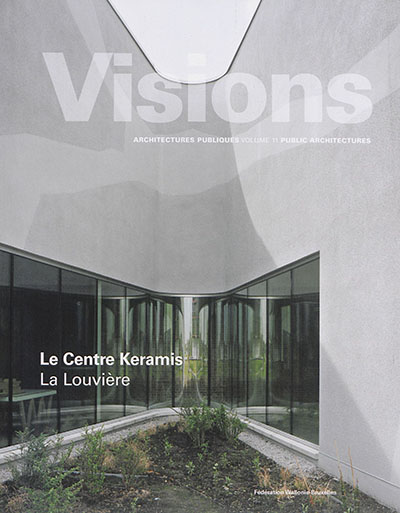
La Louvière est l'une de ces villes européennes littéralement façonnées par l'industrie locale :
alors simple hameau, elle connaît un formidable essor urbain après l'installation, en 1841,
de la Faïencerie Boch. De l'usine de 17 Ha ne subsiste aujourd'hui qu'un atelier de 1000 m<sup>2</sup>,
abritant trois fours bouteilles classés comme monument, qui sont au coeur, au sens propre
comme au figuré, du Centre de la Céramique de la Fédération Wallonie-Bruxelles. Bien plus
qu'un sanctuaire, riche d'une collection de milliers de pièces, Keramis est avant tout un espace
de création, à l'image du magnifique bâtiment conçu par le collectif d'architectes Codelenovi,
subtilement capturé par la photographe Marie-Noëlle Boutin.
Fort de son implication humaine avec les anciens travailleurs du site, l'écrivain Daniel Adam
ouvre ce livre, suivi par Ludovic Recchia qui a porté l'ambition du projet depuis ses débuts, la
doctorante Charlotte Lheureux qui revient sur les enjeux du concours d'architecture, le regard
du critique d'architecture Maarten Delbeke, le dessin averti de Jochen Gerner et enfin, le propos
de curateur d'art Benoît Dusart autour de l'oeuvre du plasticien Jean Glibert qui a ceint le bâtiment
d'une peau morcellée.
La Louvière is one of those European cities literally built by local industry: in the past a simple hamlet,
it experienced astounding urban growth after the installation, in 1841, of the Faïencerie Boch (Boch
pottery works). Of the 17-hectare plant, today only a 1,000-m2 workshop remains, housing three bottle
ovens classified as monuments, which are both literally and figuratively at the heart of the Wallonia-Brussels
Ceramics Centre, a project carried out by the Wallonia Heritage Institute. Much more than
a sanctuary, rich with a collection of thousands of pieces, Keramis is above all a creative space,
like the magnificent building designed by the architects' collective Codelenovi, subtly captured
by photographer Marie-Noëlle Boutin.
On the strength of its humanitarian involvement with the former workers at the site, writer Daniel
Adam opens this book, followed by Ludovic Recchia, who carried the ambition of the project since
its beginning, doctoral candidate Charlotte Lherueux, who reviews the challenges of the architecture
competition, the perspective of architecture critic Maarten Delbeke, the shrewd sketch by Jochen
Gerner, and lastly, remarks by art curator BD on the work of plastic artist Jean Glibert, who enclosed
the building with a broken skin.