From the ark to the pulpit : an edition and translation of the transitional Northumberland bestiary (13th century)
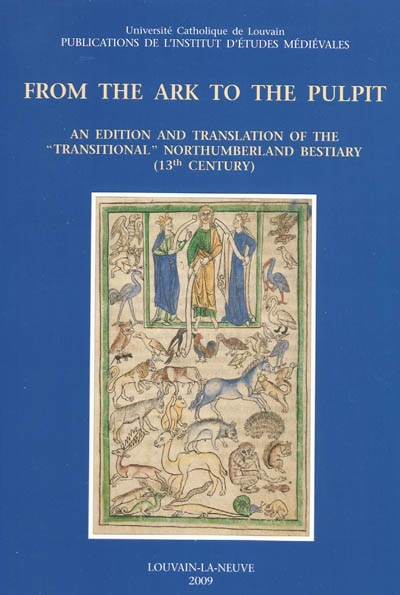
This publication of the thirteenth-century Northumberland Bestiary, formerly
the Alnwick Bestiary, provides a complete critical edition of one of the
most developed Medieval Latin bestiaries. Even among the few manuscripts in
its group, called the "transitional" family of bestiaries, the Northumberland Bestiary
is unique: it crystallizes the fluid combination of narrative, animal lore, and
spiritual guidance that characterize the genre. Beginning with creation and covering
the gamut of real and imaginary beasts, birds, fish, serpents, worms, man,
and trees, this bestiary is a spiritual journey as well as a "scientific" manual.
Under the pretense of zoology, the bestiary is a metaphor for divine creation, a
message from the creator through creation. Medieval preachers used the pretense
as well as the spiritual allegories that accompany the creatures to instruct
their congregations.
The Northumberland Bestiary was the last known bestiary in private hands
until 2007 when the J. Paul Getty Museum acquired it. Written about 1250, in
a small, early gothic book hand, it is one of the richest of all Latin bestiary manuscripts
produced in England. There are 112 finely drawn and colored miniatures
among its 74 leaves as well as an elegant and discrete "Sermon on How a
Sinner May Be Pleasing to God" ( Sermo qualiter peccator Deo placere valeat ),
which was likely directed to clerics who were training to work as pastors.
For a general as well as a scholarly readership, this edition captures the
charming essence of the bestiary tradition in a readable Latin-English format.
The book comprises a general introduction discussing the text and the manuscript,
the Latin text with English translation, notes and commentary, a description of
all the miniatures, and reproductions of about thirty of them.