Grecs et Romains en Egypte : territoire, espaces de la vie et de la mort, objets de prestige et du quotidien
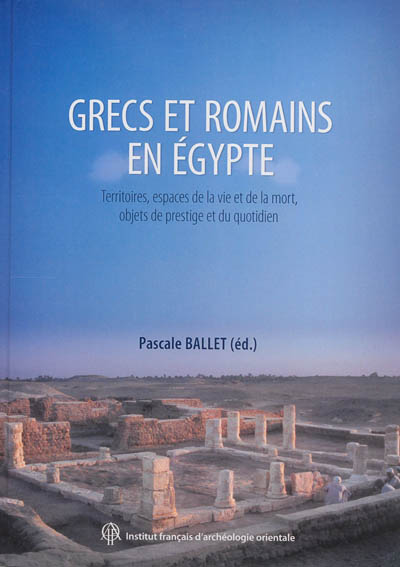
Avec l'arrivée des pouvoirs macédonien puis romain, la société de
la vallée du Nil et sa culture matérielle connaissent de profondes
mutations, bien que les traditions pharaoniques perdurent et
continuent même de s'enrichir. L'Égypte est alors l'un des leviers
essentiels de l'hellénisation et de la romanisation en Méditerranée
orientale et ses confins, notamment grâce au verrou alexandrin.
Depuis une vingtaine d'années, l'archéologie de l'Égypte gréco-romaine
connaît un net redéploiement, qui permet une réflexion élargie à
l'échelle de la Méditerranée.
Le colloque organisé par la Société française d'archéologie classique
en mars 2008 est un hommage rendu à ce développement récent
et fécond. Centrant le propos sur les «formes» spécifiques de la
présence grecque et romaine dans la vallée du Nil, il a eu pour objet
de faire connaître ces nouveaux acquis aux spécialistes du monde
gréco-romain.
La trame de cette rencontre s'organise en trois sections : de nouveaux
modes d'appropriation des territoires, en particulier ceux des fronts de
mer et des marges ; le cadre spatial, des espaces de la vie à ceux de la
mort ; les objets, au sens large, de la statuaire au mobilier. On suivra
tout particulièrement la manière dont les «modèles» des mondes grec
et romain ont été adoptés et adaptés, livrant souvent des formules
spécifiques au terrain égyptien.
With the arrival of Macedonian and Roman
powers, the society of the Nile Valley and
its material culture are going under deep
changes even though the pharaonic traditions
are surviving and at the same time
improving with new expressions. Egypt
represents one of the essential keys of the
hellenization and romanization in Eastern
Mediterranea and its borders, especially
through Alexandria.
For about twenty years, the archaeology
of the Graeco-Roman Egypt knows a deep
renewal, enlightened by the Mediterranean
environment.
The colloquium organized by the French
Society of Classical Archaeology in March
2008 wished to pay tribute to this rich
and recent development. Focusing on the
specific «shapes» of the Greek and Roman
presence in the Nile Valley, it is providing to
the scholars of the Graeco-Roman sphere
the opportunity to have access to these
new perspectives.
This colloquium is organized in three
sections: the new ways of appropriation of
the territories, especially on the sea sides
and at the borders of Egypt; the spatial
frame, in the daily life spaces and the
funerary places; the objects, in a large scale,
from the statuary to the different items of
the daily life. We will particularly follow
how the Greek and Roman «models» have
been adopted and adapted in the Nile Valley,
often revealing original and specific expressions
of the Egyptian field.