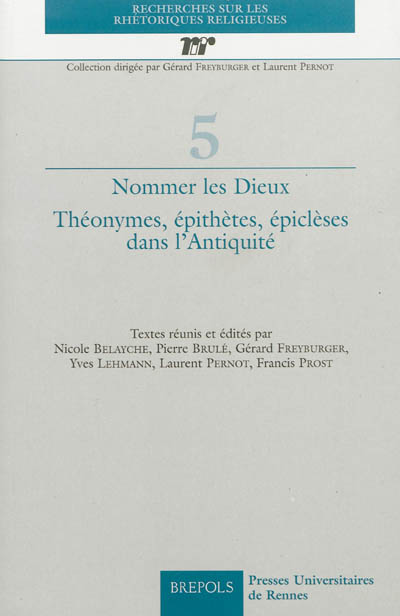
Nommer les dieux : théonymes, épithètes, épiclèses dans l'Antiquité
La collection
La collection Recherches sur les Rhétoriques
Religieuses (RRR) a pour objet le langage
dans ses rapports avec le divin, les formes
de communication avec les dieux, les différentes
manières de dire la conscience et le
sentiment religieux. Elle entend fournir
des instruments et ouvrir des voies nouvelles
pour une meilleure compréhension
de la rhétorique et de la religion.
Le présent ouvrage
Les avancées de la critique moderne sur le
mythe et sur l'histoire des religions antiques
en général ont radicalement modifié notre
manière d'examiner le nom et la nomination
des dieux. Deux axes surtout se dégagent
aujourd'hui : la question du rapport entre le
récit mythique et le nom (tout nom «parlant»
raconte) et la nécessité pour les fidèles
d'identifier le divin, de le discriminer, de le
nommer, ceci surtout dans le polythéisme,
mais aussi dans les monothéismes.
Le fait que cette identification soit commune
(et communautaire) attire l'attention sur
une autre exigence méthodologique, qui
veut qu'au-delà du signifié «entité divine»,
on n'oublie pas l'acte de langage et son
contexte inclus dans l'usage du nom, ce qui
revient à s'intéresser à sa dimension linguistique
et sociale.
A travers les religions grecque et romaine,
mais aussi, dans un esprit comparatiste, la
religion égyptienne, pharaonique et ptolémaïque,
le monde oscophone, le judaïsme et
le christianisme, à travers les textes, littéraires
et autres, en prose et en vers, les papyri, les
inscriptions, les graffiti vasculaires, le présent
ouvrage trace de nouvelles directions, à la
croisée du fait rhétorique et du fait religieux.
Issu de deux colloques organisés par les universités
de Rennes, de Strasbourg et de
Naples , Nommer les Dieux est un livre
construit et repensé, fruit d'un long processus ;
il est appelé à faire référence.
The series
The series Research on the Rhetorics of
Religion (RRR) studies language in its relationship
to the holy, the means of communicating
with the gods, the different ways of
expressing one's awareness of the divine and
the feelings which it elicits. Its goal is to provide
instruments of analysis and to open avenues
of research which will allow a better
grasp of rhetoric and religion.
The present book
Advances in the modern interpretation of
myth and in the history of ancient religion in
general have radically modified our ways of
studying the names and the naming of the
gods. Two avenues of research notably are
current today : the relationship between
the narration of the myth and the name (all
«speaking» names tell a story) and the
necessity for the faithful to identify, to distinguish
and to name the divine, in polytheisms
naturally, but also in monotheisms.
The fact that this identification is made in
common (and in community) draws attention
to another methodological requirement.
Beyond the signified «divine entity»
lie the language act and its context,
which are part of the naming : this means
that its linguistic and social aspects must be
taken into consideration.
By its treatment of the Greek and Roman
religions, but also, in the interest of a comparatist
point of view, the Egyptian religion
(under the pharaohs and the Ptolemies),
Oscan-speakers, Judaism and Christianism,
by its treatment of texts, literary and other,
in prose and in poetry, papyri, inscriptions,
vascular graffiti, the present book opens
new perspectives through the meeting of
rhetoric and religion.
The result of two colloquia organised by the
Universities of Rennes, of Strasbourg, and of
Naples , Naming the Gods is a book which has
been carefully constructed and thought out
through time ; it promises to be a landmark.