Jean-André Deluc : historian of earth and man
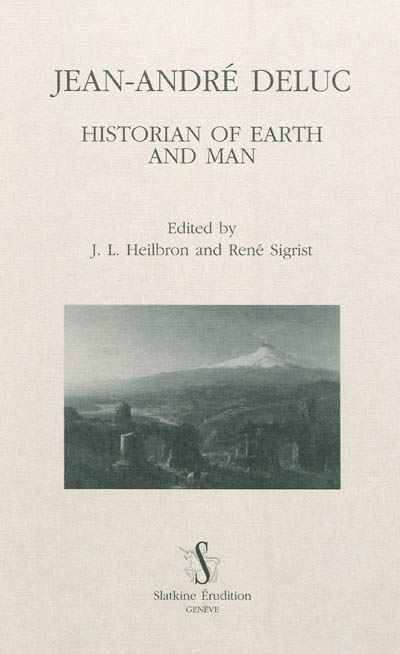
Jean-André Deluc (1727-1817) was one of the leading natural
philosophers of the eighteenth century. He was a corresponding
member of the Paris Academy of Sciences, a Fellow of the
Royal Society of London, and for a time, Professor of Geology at
the University of Göttingen. But he was not a man of the Enlightenment.
Originally a Genevan democrat close to Rousseau and
an occasional visitor at Voltaire's home in Ferney, he spent the
last half of his long life in the service of the King and Queen of
England and drifted easily and congenially to the right under
their influence. His reputation as a sober and religious philosopher
recommended him for his main assignment, reading natural
philosophy to the pious Queen, who rejoiced to find a francophone
man of science who was not a philosophe. Deluc managed
to combine the strict empiricism of an instrument designer,
experimentalist, and collector of fossils with extravagant speculations
about geology (to adapt a word he invented), meteorology,
and physics, and increasingly problematic schemes for unifying
natural, sacred, and human history. In Jean-André Deluc, Historian
of Earth and Man , J.L. Heilbron, René Sigrist, and their colleagues
trace Deluc's life beginning with his political activities in
Geneva; moving through his career in science and apologetics;
and ending with his service as a British secret agent and his
denunciations of unbelievers, revolutionaries, deists, and
chemists. The man that emerges from this assessment eludes
classification in the usual historiographical categories. His combination
of empiricism and exactness, speculation and romanticism,
shrewdness and self-delusion, science and religion, though
unusual was not unique. His story, as assembled in this book, is
a timely reminder that not all the creators of modern science
were modern scientists.