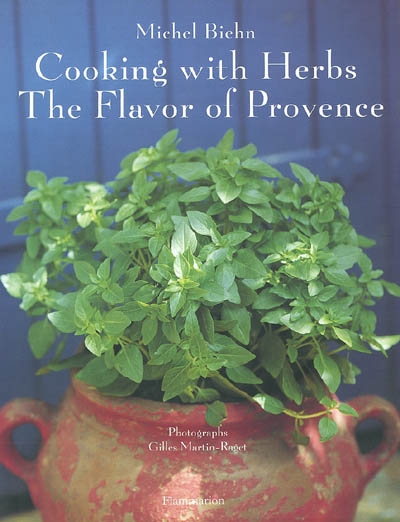
Cooking with herbs : the flavor of Provence
"There is hardly a cliché more widely used
in today's French cuisine than that of herbes
de Provence. Souvenir stores and tourist traps
abound with uninspiring little sachets, made
of printed cretonne for a `Provençal look' or
of burlap for a `natural look,' and all are
labeled `Herbes de Provence.' The sachets
contain an unidentifiable mix of dried herbs,
reduced to powder and exuding an
indefinable odor, yet supposedly containing
all the magical aromas of the wild open
countryside of Provence. What a difference
you can taste in herbs gathered on the
hillsides or grown in gardens - a rich and
wonderful natural harvest, and a cultural
treasure of Provence - precious gifts of the
land and a wonderful reminder of traditional
herb lore.
"The chefs of Marseilles and Avignon know exactly how best to use each herb, alone or
in combination with others, to flavor an omelet or a sauce. Cooking with herbs, combining
them, marrying their fragrances and flavors is an art, the result of a long, local tradition.
Of course it is accessible to any cook with feeling,
but it requires a certain initiation period, some
experience, and a touch of creativity.
"This book is first and foremost a cookbook.
Although I list the medicinal properties of each
herb, tonic or diuretic, stimulant or analgesic, I
concentrate mainly on flavor, fragrance, and the
thousand-and-one traditional or modern culinary
uses. I cook the same way my mother taught me,
the way she learned from her own mother. It is a
simple cuisine, which celebrates the special and
magnificent fragrances of Provence that are so dear
to me."
In his new work, Michel Biehn, a true fan of
Provençal cuisine, pays homage to the herbs of
Provence. He evokes their flavors, their fragrances,
and the thousand-and-one classic ways in which
they are used. In his inimitable style, Michel
Biehn presents eighty delicious Provençal recipes
collected from lovers of Provence, and explores
ancient herb lore - which herbs to use against
toothache, which can be used to concoct an Elixir
of Beauty.
We discover first of all the herbs of the hills
(including thyme, rosemary, and lavender), which
perfume the air of Provence with their subtle and
evocative scent. These herbs are used to create
such delicious dishes as potatoes stuffed with fresh
goat's cheese and wild thyme, shoulder of lamb
steamed in rosemary, or lavender nougat.
Then come the garden herbs (including aniseed,
basil, chives, coriander, and bay leaf) found in
every true Provençal kitchen, where they bring
their aromas to such treats as spelt soup stirred
with a bay twig, aniseed cookies, or juniper jam.
Finally, there are the salad greens and flowers of the
field (wild asparagus, poppy shoots, dandelion, wild
leeks, arugula, and lamb's lettuce) long gathered on
family walks, to flavor dandelion flower jelly, spice
cakes, or lasagna with wild flowers.
Each recipe is accompanied by a wine suggestion,
inviting readers to recreate the perfect Provençal
menu and to bring the sunny colors and flavors of
Provence into their own home.