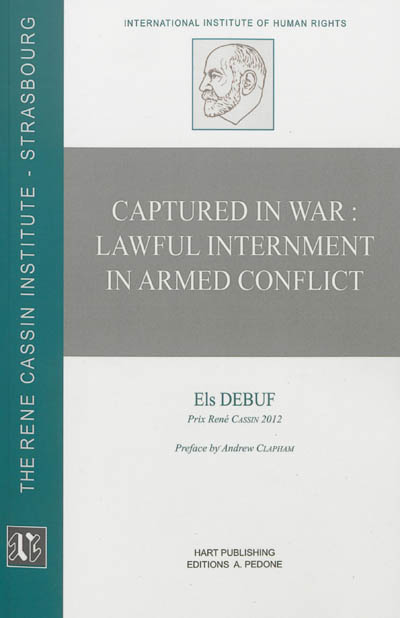
Captured in war : lawful internment in armed conflict
A security measure designed to neutralize threats from an enemy
party, internment is common in warfare. In the context of internment
operations in Afghanistan, Iraq, Guantanamo Bay and the Democratic Republic of the Congo,
and of increasing international military intervention in internal conflicts more generally, the legal
framework for internment has been widely criticised for being at best ambiguous and full of
loopholes, at worst out-dated and inadequate.
In light of such criticism, this book examines the continued relevance and adequacy of the
existing legal framework, identifies its shortcomings and proposes possible avenues to
remedy them. It offers answers to fundamental questions such as who may be lawfully interned
in armed conflict, on what legal basis, for what reasons and for how long. Starting from the
premise that internment in armed conflict cannot be lawful under one branch of international
law while at the same time unlawful under another, the book offers a fresh view of the
interaction between the simultaneously applicable norms of international humanitarian and
human rights law. Applying this approach to a comprehensive analysis of relevant normative
texts, international and national case-law and actual battlefield practice of the 20th and 21st
century, the book not only answers the questions it raises but also offers a novel perspective
on related issues such as the personal scope of application of the Third and Fourth Geneva
Conventions, the influence of international human rights law on the interpretation of
international humanitarian law and whether States need to derogate from the first in order to
rely on the latter.
Reaffirming the adequacy of the legal framework for internment in international armed
conflict and occupation, the author nevertheless demonstrates the importance of interpreting
that framework in conformity with subsequent developments in international law and actual
practice. She lays bare significant challenges in non-international armed conflict, such as the
lack of a legal basis to intern in international humanitarian law and the serious risks involved
in solutions proposed so far to remedy that gap. Indeed, sole reliance on international human
rights law, domestic law or, alternatively, on the rules on targeting are unsatisfactory and inappropriate.
Heeding calls for the clarification and modernization of the existing legal
framework for internment in armed conflict, the author puts forward concrete proposals for
normative developments that seek to reconcile both the practical realities of contemporary
armed conflict and significant developments in international law that affirm liberty as one of
the most fundamental rights owed to any human being.