Didymoi, une garnison romaine dans le désert oriental d'Egypte. Vol. 2. Les textes
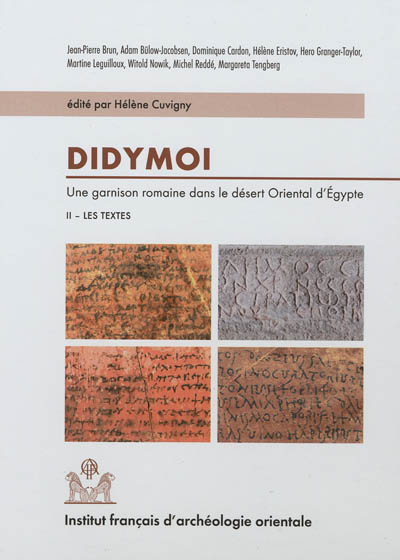
Le second volume de la publication de
Didymoi rassemble le matériel inscrit : inscriptions
lapidaires, ostraca (y compris figurés), petits objets
(les photos des ostraca sont publiées en ligne sur
le site de l'Ifao). Parfois datés, ces témoins contribuent
à la compréhension des architectures et
des stratigraphies de Didymoi, analysées dans
le premier volume. Aux deux extrémités de
l'empan chronologique, la dédicace du fort (76/77<sup>p</sup>)
et la copie d'une circulaire destinée à annoncer
aux garnisons du désert de Bérénice la bonne
nouvelle de l'association du César Maxime au
pouvoir impérial (236<sup>p</sup>). Outre les documents
générés par la routine du service et du ravitaillement
(journaux de poste, laissez-passer, ordres
de livraison, comptes, tituli vasculaires), les lettres
privées envoyées des garnisons voisines abondent
en instantanés sur la vie des militaires stationnés
dans les fortins du désert Oriental et sur celle des
civils, qui tempéraient l'inconfort et l'ennui de
cette affectation. Un marchand préfère vendre
sa viande à Bérénice malgré la demande locale,
un helléniste compose péniblement une lettre
en latin au moyen d'un glossaire ; tel débouche
une amphore pour remercier le camarade venu
du fortin voisin l'aider à faire son pain ; un curator
praesidii a été prié par ses hommes d'écrire à un
proxénète pour passer commande de sa «petite
esclave, celle à soixante drachmes» ; un homme
félicite une nouvelle accouchée ; il a, en action de
grâce, allumé une lampe à Aphrodite ; un cavalier
s'inquiète pour un jeune chien qui l'a suivi alors
qu'il s'éloignait à cheval et qui n'est pas rentré
au fort. Dans les installations romaines du désert
Oriental, les documents demeurés sur place
- parce qu'ils ont été mis au rebut - ne sont pas
les sources dont rêve l'historien. Une synthèse
liminaire fait le point sur ce qu'ils apportent
néanmoins à la connaissance du maillage militaire
dans cette zone de transit caravanier.
The second volume of the publication of
Didymoi contains the inscribed material, such as
inscriptions on stone, ostraca with text or images,
and small objects (the photos of the ostraca are
published online on the Ifao website). As they
are sometimes dated, these objects contribute
to the understanding of the architecture and
stratigraphy of Didymoi that was published in
the first volume. At the extremities of the chronological
span we have the dedication of the fort
(AD 76/77) and the circular letter to the garrisons
of the desert of Berenike announcing the good
news that Maximinus Thrax promoted his son
to Caesar (AD 236). Apart from the documents
generated by the military routine and the provisioning
of the fort, such as postal registers, passes,
orders to deliver, accounts, and inscriptions on
jars, there are a great many private letters sent
from neighbouring stations. These letters give
us snapshots of the life of the soldiers who were
stationed in the forts of the Eastern Desert and
of the civilians who mitigated the boring discomfort
of this service. A merchant prefers to sell his
meat in Berenike in spite of local demand. A Greek
speaker painstakingly writes a letter in Latin with
the help of a glossary. Someone opens a jar of
wine to thank a friend who has come from a
neighbouring fort to help him make his bread.
A curator praesidii has been asked by the men to
write to a procurer to order 'your girl who makes
you sixty drachmas'. A man writes to congratulate
a woman on the birth of her child, saying that he
has lit a lamp to Aphrodite in gratitude. A horseman
is worried about a young dog that followed
his horse when he left the fort, but has not come
back. In the military establishments of the Eastern
Desert the documents that remain to be found
have remained because they were thrown away,
and are not the sources that historians dream
of. Nevertheless, an introductory chapter gives
a synthesis of what they do contribute to our
knowledge of the military network in this zone
passing caravans.