Paul & Henri Carnal Hall : les arts au service de l'éducation : une vieille idée si moderne !. Paul & Henri Carnal Hall : using the arts for education : a modern twist on a classic idea !
Fondé en 1880, l'Institut le Rosey à Rolle (Suisse) est le
plus ancien pensionnat suisse à vocation internationale.
Le Rosey ne cesse d'innover en matière d'éducation
et le dernier bâtiment de son campus, le Paul & Henri
Carnal Hall, est le résultat d'une collaboration particulièrement
fructueuse entre la vision de son directeur
actuel, Philippe Gudin, et le génie de l'architecte
Bernard Tschumi.
La vieille idée du rôle essentiel de la connaissance
et de l'expérimentation des domaines artistiques
réclame une nouvelle approche propre à notre siècle,
notamment face aux nouvelles technologies. Ici, l'art est
vecteur de connaissances, promoteur de sensibilité mais
surtout catalyseur d'imaginaire ; son échange et son
apprentissage se font par un dialogue interdisciplinaire.
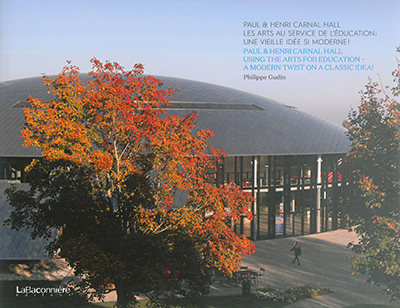
Le dôme roséen permet la circulation et l'échange ;
son dessin est résolument moderne sur un campus
à l'architecture traditionnelle.
Le texte de Philippe Gudin sur l'importance d'un tel
bâtiment au service de l'éducation est enrichi d'une
interview à deux voix avec Bernard Tschumi.
Founded in 1880, Institut Le Rosey in Rolle is the
oldest international boarding school in Switzerland.
Le Rosey is known for its ceaseless educational
innovation but also for the latest addition to its
campus, the Paul & Henri Carnal Hall. This building
is the result of a particularly fruitful collaboration,
which combines the vision of the current director,
Philippe Gudin, with the genius of architect
Bernard Tschumi.
The old idea of the essential role of knowledge
and experimentation in artistic fields needs to be
revised to fit the 21<sup>st</sup> century, particularly given the
advent of new technologies. Here, art is a vehicle for
knowledge: it promotes sensitivity but, above all, it
is a catalyst for the imagination interdisciplinary
dialogue provides the forum for artistic exchanges
and apprenticeships.
The Roséen dome facilitates this flow of ideas and
these exchanges thanks to its resolutely modern
design in the midst of the traditional architecture
of the campus buildings. Philippe Gudin's text
on the importance of this building for education
is supplemented by a two-person interview with
Bernard Tschumi.