Ambivalent rage : youth gangs and urban protest in Conakry, Guinea
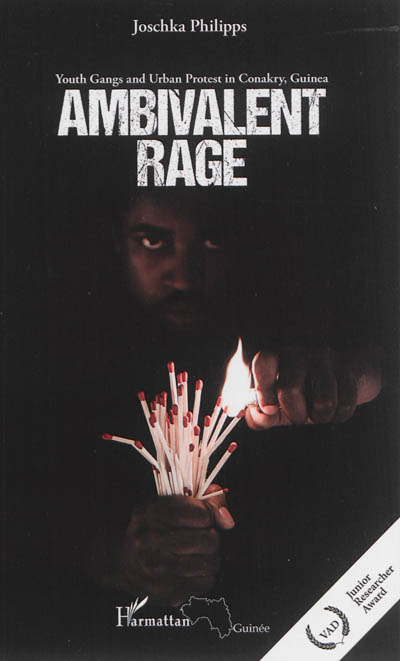
Why do urban youth gangs protest against a political regime? And why do their protests occur
right in the center of a capital city?
Ambivalent rage investigates the world of youth gangs and politics in the West-African city of
Conakry, Guinea. It sheds light on how young men organize in gangs, how they perceive, confront
and collaborate with the political elite and how this translates their precariousness into political
instability.
"This study is a very rich contribution to the general theoretical debate on youth popular
culture, democracy, governance and the African state. An original and solid analysis of both the
discursive and physical presence of the Guinean youth in the public space, it tracks meticulously,
beyond the politics and economics of the youth predicament, the culture and imaginary attached
to youth. Its specific examples are drawn from a copious use of written and oral sources associated
to a solid ethnographic exploration of the Guinean social and political scene."
Prof. Mamadou Diouf, Columbia University, New York
"This invaluable work explores urban youth gangs in Conakry, Guinea. Tightly disciplined and
organized, their action extends well beyond the criminality implied by the term. The precarious
situation and uncertain prospects of urban youth, and their frequent rage at their marginality, make
them a volatile social force. They are at once an appealing target for political instrumentalization,
but hard to control. The informed and insightful analysis in this succinct book is of comparative
application to many large African cities."
Prof. Crawford Young, University of Wisconsin-Madison
"In Ambivalent Rage , Joschka Philipps grasps the urbanity of even the most seemingly limited of
cities - that despite clear absences of infrastructure and effective provisioning and management,
residents intersect the various tools at their disposal, such as ethnic affiliation, class differentiation,
geographic location, and the specificities of the built environment to elaborate the potentialities of
their circumstances. Philipps incisively analyzes how youth put together specific tools for relating
to everyday conditions, and that assuming these tools places youth within very specific demeanors
and orientations."
Prof. Abdou-Maliq Simone, Goldsmiths College, London