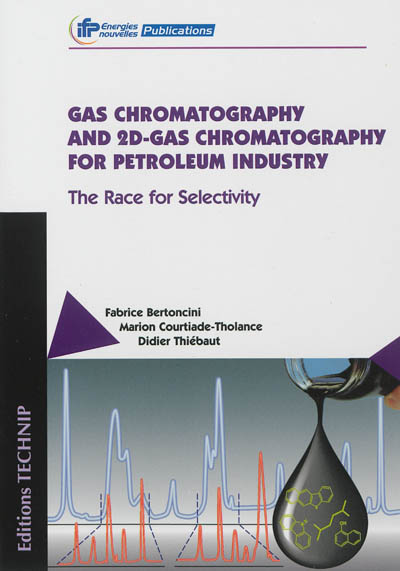
Gas chromatography and 2D-gas chromatography for petroleum industry : the race for selectivity
Detailed knowledge of petroleum products at molecular scale has always been
essential to understand the mechanisms leading to their formation, to design
thermodynamic and kinetic models employed in the refining processes and to predict
their physical properties. In view of the complexity of petroleum products, very
significant research efforts have been made over the past 15 years for improving
relevant analytical techniques, especially in the field of Gas Chromatography in order
to improve its separation power. The advent of comprehensive Two-dimensional
Gas Chromatography (GCxGC) at the end of 1990's constitutes a true revolution
allowing an unprecedented insight into very complex mixture at the molecular level.
This book aims at providing a complete review of the implementation of Gas
Chromatography in the field of oil industry, with an important focus on GCxGC
and related multidimensional systems. It is therefore organised into 8 chapters
dealing with fundamental and experimental aspects as well as data processing
challenges. Recent progress in the development of these chromatographic systems
are discussed according to various applications: detailed molecular analysis of
hydrocarbons, speciation of hetero-element, global properties calculation based
on chromatographic data and simulated distillation. Specialists from IFP Energies
nouvelles, CNRS and major companies leading important research in this field
have contributed, reporting a synthesis of the knowledge acquired from research
these last 15 years.
Thus, this book will be useful for anyone involved in the separation of oil and
derivatives: the student starting a research project, the academic researcher and the
refinery engineer willing to deepen their knowledge on advanced multidimensional
Gas Chromatography, as well as molecular analysis of petroleum products.