Eero Saarinen
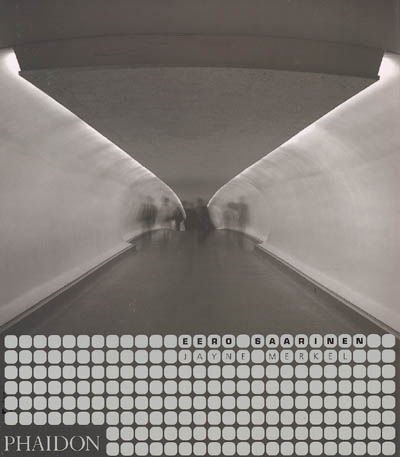
For more than half a century people have marveled at the sweeping
forms of the Trans World Airlines terminal at Kennedy Airport
in New York, lined up to enter the catenary Saint Louis Gateway
Arch, and admired the mid-century modern lines of Knoll's
"womb" and "tulip" chairs. Yet few can name the designer of
these wide-ranging projects: Eero Saarinen (1910-1961).
One of the world's most celebrated architects at the time of his
death at the age of 51, the Finnish-born, American-trained master
of Modernism designed and built more than thirty-five buildings
in his brief lifetime, and more than thirty other projects in collaboration
with his father and such celebrated architects as Charles
Eames and Ralph Rapson. Saarinen's career began in childhood:
As the son of renowned architect Eliel Saarinen, designer of
Cranbrook Academy in Bloomfield Hills, Michigan, Eero grew
up in an intellectually charged environment surrounded by art
and design. Eero Saarinen trained and practiced with his father
until the early 1950s, when he established his own firm and
began to design some of the most influential institutions of his
day, among them residential colleges and a hockey rink at Yale
University, an auditorium and chapel at the Massachusetts
Institute of Technology, American embassies in London and
Oslo, and corporate headquarters for General Motors, IBM,
and Bell Laboratories.
This volume is the most definitive monograph published to date
on Eero Saarinen. It traces Saarinen's life and career from his child-hood
in Finland to collaboration with his father, through his iconic
airport projects of the 1960s, documenting more than sixty commissions
and competitions. Extensive illustrations include period
photography by Ezra Stoller, Balthazar Korab, and others; rarely
seen original sketches, concept drawings, and plans, and more
recent color photography.