Devins et lettrés dans l'orbite de Babylone : travaux réalisés dans le cadre du projet ANR Mespériph 2007-2011
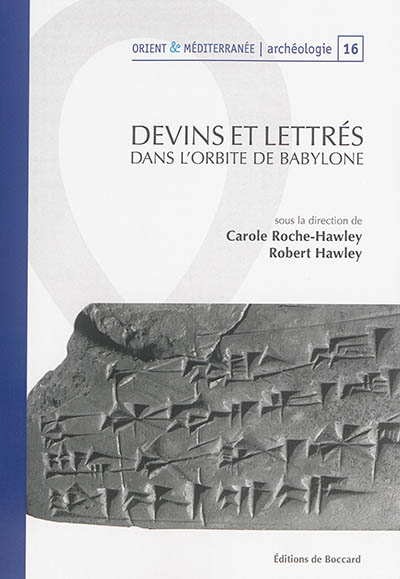
Cet ouvrage est le second volume des publications issues des travaux réalisés
dans le cadre du projet ANR Mespériph, «La Mésopotamie et sa périphérie :
transmission et adaptations d'une culture au Bronze récent».
Dans ce second volume, en plus de la poursuite de l'étude de certains scribes et
de pratiques scribales locales, ce sont les devins et autres lettrés plus spécialisés qui
ont retenu l'attention. Ces disciplines savantes révèlent de façon claire la transmission
des traditions cunéiformes en Syrie et en Anatolie, mais elles illustrent aussi des liens
subtils entre les usages «d'origine» et les adaptations locales, entre les continuités
avec le passé et les innovations et évolutions en contexte étranger...
À travers l'étude de textes de la tradition babylonienne copiés hors de Babylonie,
qu'ils soient scolaires, littéraires ou divinatoires, certaines contributions se sont intéressées
aux chemins que ces textes ont empruntés et aux relais ayant fonctionné.
D'autres études ont quant à elles poursuivi l'examen de l'adaptation de la langue babylonienne
et de l'écriture cunéiforme mésopotamienne dans ces zones «périphériques»,
notamment à travers le décalage entre l'apprentissage et l'usage de ces outils : à Ougarit,
par exemple, on assiste aussi à la constitution d'un savoir local écrit avec l'alphabet
suivant un modèle babylonien, ou encore au jeu de la mise au point d'un vocabulaire
technique pris entre langues de prestige, langues d'origine et langues locales.
This is the second volume of publications devoted to research accomplished within
the framework of the "Mespériph" project ("Mesopotamia and its periphery:
transmission and adaptations of a culture in the Late Bronze Age", funded by the
French Agence nationale de la recherche 2007-2011).
In this second volume, in addition to pursuing the study of certain scribes and
local scribal practices, it is diviners and other kinds of specialized scholars that have
retained the attention of the contributors. Such learned disciplines not only provide
a particularly revealing vantage point for the study of the transmission of cuneiform
tradition in Syria and Anatolia, but also illustrate the subtle relationship between
"original" usages and local peripheral adaptations, between continuity with the past
and innovation and evolution in a foreign setting.
Through the study of these Babylonian scholarly texts copied outside of Babylonia,
be they scribal exercises, literary texts or divination manuals, some contributions to
this volume focus on the paths followed by these texts over the course of their
transmission and on the various scribal centers through which they passed. Others
trace the adaptation of the Babylonian language and Mesopotamian cuneiform
writing system in these so-called "peripheral" zones, highlighting the gap between
learning and actually using this scholarly knowledge at Ugarit, for example, where
Babylonian textual models also served as inspiration for the constitution of a local
written "cultural repertoire" in alphabetic script, or shedding light on the complexities
involved in the evolution of technical vocabulary, in a dynamic between linguistic
prestige and vernacular or dialectal realities.