Dramatic battles in eighteenth-century France : philosophes, anti-philosophes and polemical theatre
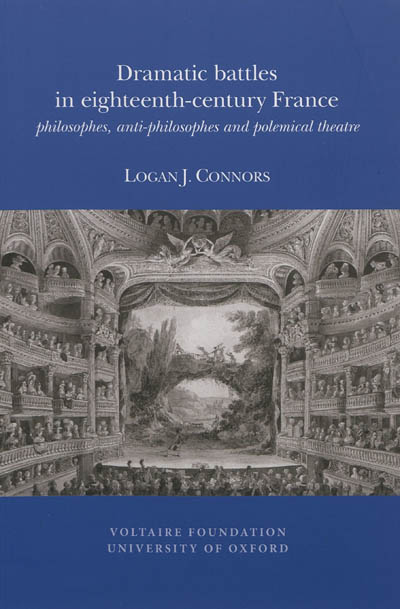
The mid-eighteenth century witnessed a
particularly intense conflict between the
Enlightenment philosophes and their enemies,
when intellectual and political confrontation
became inseparable from a battle for public
opinion. Logan J. Connors underscores the
essential role that theatre played in these
disputes.
This is a fascinating and detailed study of the
dramatic arm of France's war of ideas in which
the author examines how playwrights sought to
win public support by controlling every aspect
of theatrical production - from advertisements,
to performances, to criticism. An expanding
theatre-going public was recognised as both a
force of influence and a force worth influencing.
By analysing the most indicative examples
of France's polemical theatre of the period,
Les Philosophes by Charles Palissot (1760) and
Voltaire's Le Café ou L'Ecossaise (1760), Connors
explores the emergence of spectators as active
agents in French society, and shows how theatre
achieved an unrivalled status as a cultural
weapon on the eve of the French Revolution.
Adopting a holistic approach, Connors provides
an original view of how theatre productions
'worked' under the ancien régime , and discusses
how a specific polemical atmosphere in the
eighteenth century gave rise to modern notions
of reception and spectatorship.