Light's labour's lost : policies for energy efficient lighting, in support of the G8 plan of action
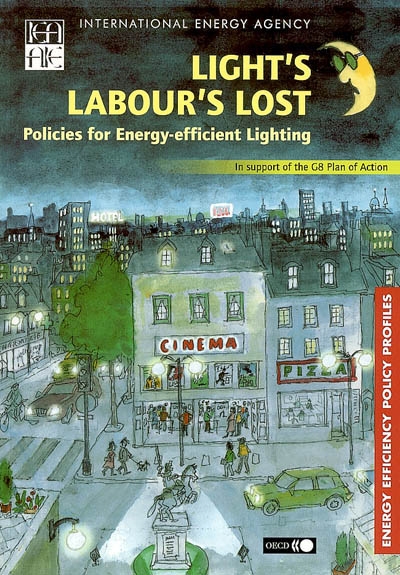
When William Shakespeare wrote Love's Labour's Lost , he would have used light
from tallow candles at a cost (today) of £12 000 per million lumen-hours. The
same amount of light from electric lamps now costs £2, while the supply of
artificial light in the country of Shakespeare's birth has increased 350 000 times!
But this illumination has a dark side. Globally, lighting consumes more electricity
than is produced by either hydro or nuclear power and results in CO<sub>2</sub> emissions
equivalent to two-thirds of the world's cars.
A standard incandescent lamp may be much more efficient than a tallow candle,
but it is far less efficient than a high-pressure sodium lamp. Were inefficient light
sources to be replaced by the equivalent efficient ones, global lighting energy
demand would be up to 40% less at a lower overall cost. Larger savings still could
be realised through the intelligent use of controls, lighting levels and daylight.
But achieving efficient lighting is not just a question of technology; it requires
policies to transform current practice. This book documents the broad range of
policy measures to stimulate efficient lighting that have already been
implemented around the world and suggests new ways these could be
strengthened to prevent light's labour's from being lost.