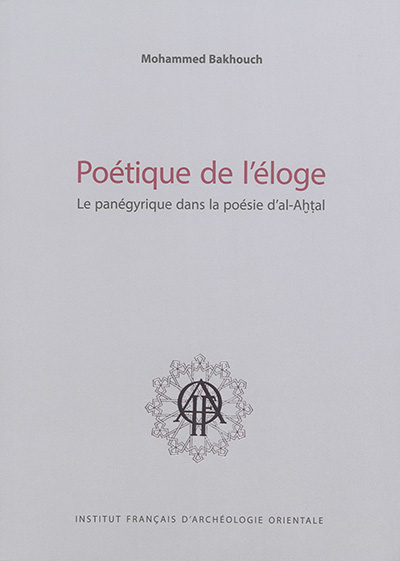
Poétique de l'éloge : le panégyrique dans la poésie d'al-Ahtal
Art séculaire et bien vivant aujourd'hui, le panégyrique [ madih ] n'a pas suscité beaucoup d'intérêt
parmi les chercheurs.
Pourtant, l'analyse des madih -s du poète umayyade al-Ahtal [m. 710 J.C.] montre que loin d'être
un simple portrait flatteur du dédicataire, le panégyrique, qui érige ce dernier en modèle, est en
fait le réceptacle des valeurs cardinales auxquelles adhère toute une société.
D'autre part, dépositaire de la mémoire collective, le panégyrique est également un poème
dans lequel s'expriment une vision du monde et un imaginaire nourris par des croyances qui
remontent à des temps immémoriaux.
Sur le plan de la structure, la qasida de madih se révèle être, non pas une juxtaposition d'éléments
disparates, mais bien un ensemble organiquement uni, dans lequel différentes composantes
sont susceptibles de figurer.
Enfin, considéré dans une perspective maussienne (voir l' Essai sur le don ), le panégyrique s'inscrit
dans le cadre d'un échange. Motivé par la haga [requête], il constitue le don par lequel le poète
oblige son dédicataire.
As a centuries-old art still alive today, the panegyric [ madih ] did not arouse much interest among
scholars. Yet, the analysis of the madih -s, by the famous al-Ahtal [d. 710 A.D] shows that, far
from being a mere flattering and superficial portrait of the man in power or the dignitary, the
panegyric, by making the dedicatee [ mamduh ] a model, becomes de facto the receptacle of the
cardinal values on which a whole society agrees.
Besides, mobilizing the collective memory, the panegyric is also a poem in which a vision of the
world is expressed, as well as a fertile imaginary, nourished by now degraded beliefs and myths,
coming from immemorial times, and taking shape from the topoi and figures of speech it harbors.
In regard to its structure, rather than the juxtaposition of scattered elements, the madih poem
appears to be an organically united ensemble, in which various components can be found, for
various reasons.
Finally, according to the Mauss perspective (see The Gift ), the panegyric comes within the scope
of an exchange of gifts. Motivated by the haga [quest], it is a gift through which the poet obliges
and compels his dedicatee.