China : the photographs of Edward Burtynsky
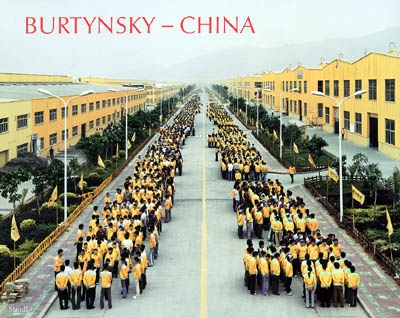
"Unless, like me, you already admired industrial sites for reasons of
personal history, Burtynsky's images can be therapeutic by introducing
aesthetic doubt into your culturally determined sensibility."
Marc Mayer
"As urban as China's modern cities look, they are vast collections of
country folk who have left home in the past few years. These new
urbanites exist in the middle of a single generation that will send
300 million people to China's cities and are creating the urban
industrial future that is changing the tilt of the world."
Ted Fishman
"Burtynsky's treatments of China are poised at a moment of alarming
perplexity: how high can it all go before something comes
crashing down?"
Mark Kingwell
"To be rich is to be glorious!" With these words, in
1992 Deng Xiao Ping announced to his countrymen,
and to the world, that China was ready to embrace
Western lifestyles. In 1978, a national economic
revitalization program that began with widespread
land reforms and in the early 1980s was further
fuelled by the establishment of Special Economic
Zones (SEZ). These long-awaited constitutional
reforms swept the Chinese population headlong
into an optimistic future. While surveying the evolution
of SEZ in southern China, the aging chairman
made this declaration and in so doing kick-started
a developmental process that was stalled in the
aftermath of Tiananmen. The impact of Chinese
passions to share in our contemporary way of life is
plainly felt both in global economics and on the
world's ecology.
In this book, Edward Burtynsky presents photographs
of the remnant and newly established
zones of Chinese industrialization-those places
created while realizing the "glory" of wealth for a
powerful civilization yearning to move forward and
join the ranks of modern nations. Using diplomatic
channels, Burtynsky has gained rare access to these
sites, creating images that are at once arresting and
unsettling. These photographs afford us privileged
glimpses of the vast social and economic transformation
currently underway in China.
Burtynsky casts a watchful eye over the extreme
expressions of Chinese industry. His subjects
include the Three Gorges Dam, at present the
world's largest engineering project and Bao Steel,
China's biggest steel producer. He explores the
vanishing dinosaurs of old industrial complexes in
the north eastern "rust belt" and shipyards at
Qiligang, the single most concentrated area of
shipbuilding in the country.
His camera penetrates into entire villages dedicated
solely to the recycling of electronic waste,
plastics and metals where the painstaking work of
sorting is done by hand. We are taken to see the
internal vistas of seemingly infinite factory floors
such as that of Cankun, the world's largest maker
of irons (23,000 employees); Yu Yuan, a sport shoe
manufacturer that employs 90,000 and Deda,
China's principal chicken processor. Finally,
Burtynsky turns his attention to the landscape of
cities, zeroing in on the new, tall China of high density
centers like Shanghai, where countless skyscrapers
quickly replace an older, once graceful
incarnation to accommodate the mass influx of
new and hopeful urbanites.