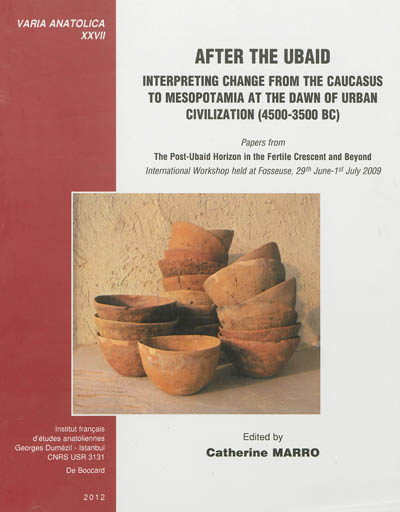
After the Ubaid : interpreting change from the Caucasus to Mesopotamia at the dawn of urban civilization (4500-3500 BC) : papers from the post-Ubaid horizon in the Fertile Crescent and beyond, international workshop held at Fosseuse, 29th June-1st July 2009
The time period between the end of the Ubaid and the beginning of the Uruk
expansion is one of the least known, yet most important eras in the ancient
history of the Middle East. This era, which is often referred to as the "Post-Ubaid"
period, is marked by major structural changes such as the rise of social
hierarchies, technological innovations and economic reorganisation, which
eventually led to the emergence of proto-states and cities. The recent finding of
"Post-Ubaid-related" sites in regions deemed to be located far beyond the Ubaid
purview, such as Cilicia, Cappadocia or the south Caucasus, has added another
dimension to this picture: these sites suggest that the organic relationships more
or less implicitly established between the "Post-Ubaid horizon" and the Ubaid
world may in fact be much weaker than once thought. Through a systematic
review of contemporary artefacts retrieved from recent and less recent excavations
in the south Caucasus, eastern Anatolia and the Fertile Crescent, this book is an
attempt to assess the available data from a broader, that is not Mesopotamianspecific,
perspective.