5th international symposium on the mediterranean pig : Tarbes (France), 16-19 november 2004. 5ème symposium international sur le porc méditerranéen : Tarbes (France), 16-19 novembre 2004
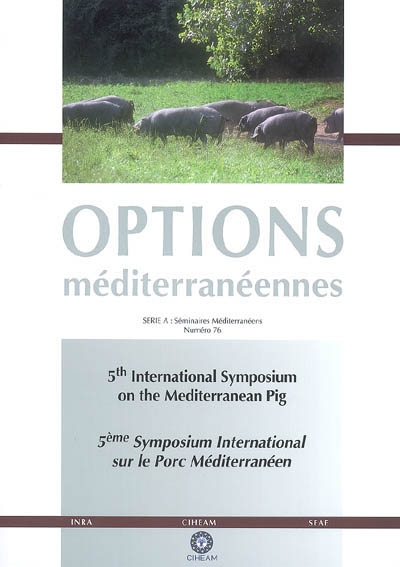
Since the first edition, held in 1989 in Ajaccio (Corsica), the International Symposia on
the Mediterranean Pig have been held in Badajoz (Spain) in 1992, Benevento (Italy) in
1995, and Evora (Portugal) in 1998. The 5th International Symposium on the
Mediterranean Pig was held in Tarbes (France) from 16 to 19 November 2004. The
choice of the Symposium venue rested on the South-West of France, where two
production sectors working with local breeds for typical products are in full
development: the Basque pig of the Valley of Aldudes and the Gasconne pig of Bigorre.
The Symposium was organised in three sessions, corresponding to the driving factors
that accompany the key points of the theme of interest:
(i) The genetic choices compatible with a quality and typificity specific to the traditions
of Southern Europe. They include both the cosmopolitan genotypes selected for this
objective and the local breeds, revisited due to their appropriate aptitudes and now
recognised in their contribution to the biodiversity of farm animals.
(ii) Feed resources linking farming systems to specific biotopes, where pig farming
contributes directly to their constitution, valorisation and associated landscapes and
where the responsibility of the farmers and the production sectors lies in ensuring the
continuation of such biotopes and their environmental role.
(iii) Processing know-how in order to be able to take advantage of the carcass, meat and
fat potential coherent with the technical and gastronomical cultures associated with
these specialised productions of high added value in the target markets.
To these three pillars we could add other important elements such as health aspects or
the challenges of animal welfare which arise as a result of the extensive nature of many
situations, or even the need to develop control strategies for products adapted to
production standards. Furthermore, with every step forward identified through our
regular exchanges, we make progress in our capacity to formulate and address the
challenges for the generation of knowledge.
These Proceedings publish 58 communications that were distributed in the three
sessions of the Symposium, both as main conferences, oral and poster presentations.