Afghanistan, the making of the 1964 Constitution : memoirs of Sayed Quassem Rishtya
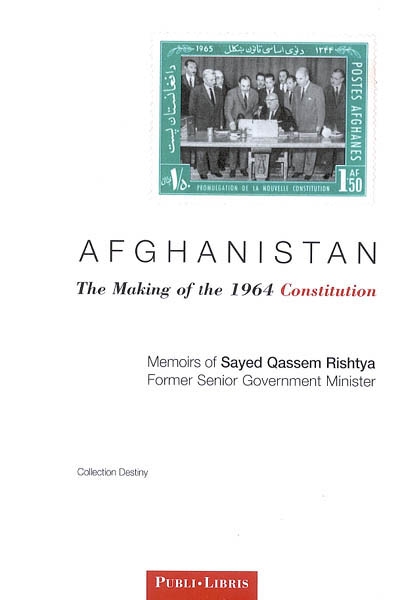
This account is taken entirely from Sayed
Qassem Rishtya's personal diaries and
recollections of his time as a Minister
between 1963 and 1965 told with
unflinching honesty and insight. There is
no historical precedent in Afghanistan for
a discussion of political affairs in the form
of a personal narrative. Much of his story is
firsthand, including private conversations
with world leaders.
Of particular relevance to today's events
was his involvement in Afghanistan's first
democratic Constitution, written and
adopted in 1964 - the period when Afghan
women in European dress held seats in
Parliament and filled the Universities away
from the eyes of the media.
Not only was he one of the principal
authors of the model document, he was also
one of the leading players in the political
manoeuvring taht led to its adoption. His
insistence to adopting the Constitution to the
letter earned him the respect of his colleagues,
but also antagonised opponents, causeing a
rift in the Afghan body politic.
His integrity and deft handling of the oftconflicting
concerns of multiple political,
religious and tribal factions, in particular as
it concerned the constitutional reforms, since
they are now partially reinstalled in the 2004
Constitution, could be a model for the
country's effort once again to bring democracy
to that troubled land.
One of the highlights, of this remarkable
account is President Kennedy's caution to
Zahir Shah, during the latter's official visit
to the United States in 1965, about the
dangers of the democratic reforms then
underway in Afghanistan and the need to
proceed cautiously !
The original manuscript and diaries may
well have been lost to posterity were it not
for the courage of an Austrian diplomat, who
smuggled them out of the country under the
noses of the Soviet occupiers.
Sayed Qassem Rishtya was himself forced
to flee, taking only the clothes he stood up
in, in the wake of Soviet Russia's blitzkrieg
during 1979. His name figured on a list,
prepared in the aftermath of the Communist
Coup, of those who were not allowed to
leave the country.
The tanslation into English by his
daughter presents the readers with a personal,
account of diplomacy and government
intrigue at the highest levels, told in an
intimate manner that makes us feel as if we
were there.