Atlas of amphibians and reptiles in Europe. Recent changes in the taxonomy of European amphibians and reptiles
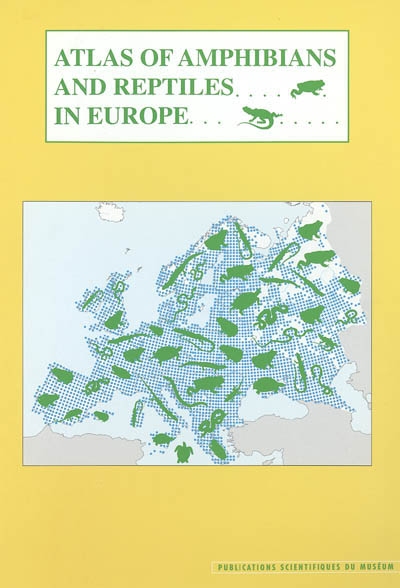
The publication, in 1997, of an Atlas of Amphibians and Reptiles in Europe was the culmination of an
unprecedented effort to accurately map the distribution of Europe's 62 amphibian and 123 reptile species
occurring west of the Urals.
Work on the Atlas began at the initiative of the Societas Europaea Herpetologica (SEH) in 1983, when its
Mapping Committee was created. Under the supervision of the Committee, the Muséum national
d'Histoire naturelle (Paris, France) coordinated the methodological, technical and scientific aspects and was
entrusted with the publication of the Atlas. The data were collected by numerous enthusiastic specialists,
both professionals and volunteers, and collated by a network of national coordinators, resulting in a database
of 85,067 records. Each species is represented in the Atlas by a 50x50 km UTM grid distribution map,
together with notes on its taxonomy, distribution, population status and conservation problems. These are
supplemented by a bibliography containing more than 1,300 entries. Information on the extinction or introduction
of certain species is also highlighted on the maps.
The present volume is a second edition of the Atlas , with a review of the taxonomic and nomenclatural
changes that have occurred during the last 10 years. The Societas Europaea Herpetologica recognizes that
it has also become necessary to revise and update the maps themselves. However, this is a project that will
take several years and, in the meantime, the information in the maps of the first edition remains the best
available.
The Atlas of Amphibians and Reptiles in Europe will be of immense value to researchers, managers and
conservationists alike. It will no doubt be used for national and global Red Data Books and for defining
the responsibility of each State where the herpetological heritage is concerned.