Representing the violence in France : 1760-1820
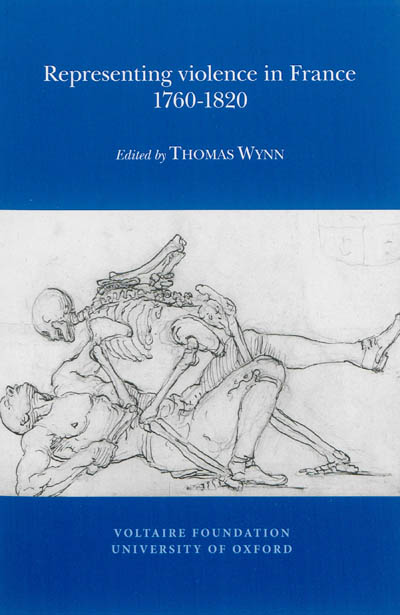
Violence was an inescapable part of people's daily
lives in eighteenth-century France. The Revolution
in general and the Terror in particular were
marked by intense outbursts of political violence,
whilst the abuse of wives, children and servants
was still rife in the home. But the representation of
violence in its myriad forms remains aesthetically
troublesome.
Drawing on correspondence, pamphlets, novels
and plays, authors analyse the portrayal of violence
as a rational act, the basis of (re)written history, an
expression of institutional power, and a challenge
to morality. Contributions include explorations of :
- the use of the dream séquence in fiction to
comprehend violence ;
- how rhetoric can manipulate violent
historical truth, as documented by Burke in
his Reflections on the Revolution in France ;
- the political implications of commemorating
the massacre at the Tuileries of 10 August
1792 ;
- how Sade's graphic descriptions of violence
place the reader in a morally ambivalent
position ;
- the differing responses of individuals
subjected to brutal incarceration at
Vincennes and the Bastille ;
- the constructive force of violence as a means
of creating a sense of self.