Man and river systems II : interactions among rivers, their watersheds and the sociosystem : extended abstracts booklet, international symposium Paris, december 4-6, 2006
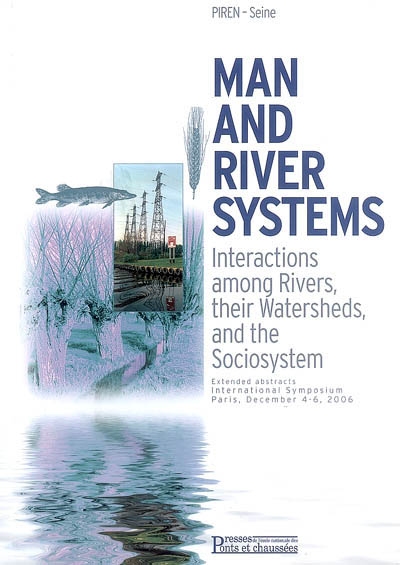
This book gathers the extended abstracts of the presentations given
at the international symposium "Man and River Systems II; Interactions
among Rivers, their Watersheds and the Sociosystem", Paris, December
4-6, 2006. The symposium was organised by the PIREN-Seine
programme, a major long lasting scientific project enabling long term
ecological research at the river basin scale. At this scale, the ecosystem
to consider is based on complex interactions between the natural system
and the sociosystem.
Unlike the previous Man and River Systems symposium which major
subject was the interaction between biological, chemical and physical
processes at various scales within the watershed, our present objective
is to promote interdisciplinarity between natural and social sciences.
Historians, sociologists, economists thus provided key inputs to the
symposium.
The symposium addressed physical, geochemical and microbial processes
that are studied within river ecosystems and their catchments. These
elementary processes are involved in the transformations, circulations
and cycling of natural elements and contaminants along their transfers
across all compartments of the hydrosystems. A strong focus is given
on the interactions between aquatic and terrestrial systems, such as
diffuse sources and sinks. This includes historical descriptions of the
pressures as well as present time analysis of the fluxes and impacts of
nitrogen, phosphorus, total solids, metals, pesticides at the river basin
scale. An important final outcome of this complex set of processes and
pressures is the ecological status of the hydrosystem. A series of presentations
illustrate a panel of approaches which have been developed
to assess the ecological status of river systems at the basin scale in
relations to applied stresses. Last but not least, because of the major
importance of human activities in river basin ecosystems, evaluating
public policies and technical tools for river basin management. The efficiency
for various economic tools is discussed, and compared to more
politic incentives, including the strongly demanded public participation.
Numerous case studies illustrate this topic.