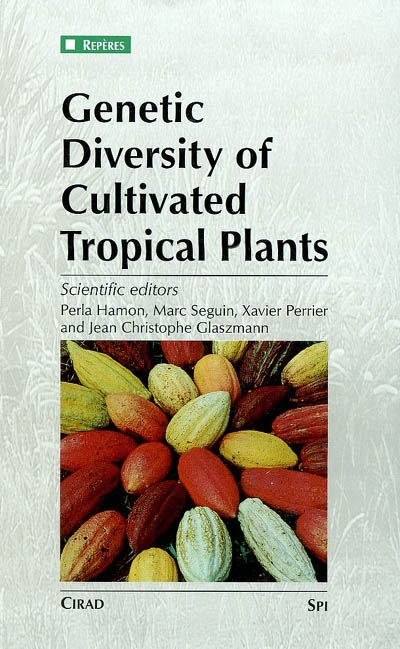
Genetic diversity of cultivated tropical plants
About the Book
It was in the 1960s that the scientific community first became aware of
the threat that disruption of natural environments posed to the
germplasm of numerous cultivated species. It began working to
collect that germplasm, and a multitude of collections were set up
worldwide. These collections are now so large that they are proving
difficult to maintain and characterize, and their management has
become a crucial issue. Germplasm conservation, evaluation, and use
all need to be rethought.
In response to those concerns, Frankel and Brown introduced the
idea of core collections in the 1980s : a sample of accessions from a
larger collection is taken to provide as accurate a picture as possible of
the existing range of diversity. However, what criteria and tools should
be used to put together the sample ?
Agronomic criteria are primordial for breeders but are sometimes
difficult to evaluate, and their genetic determinism is often complex.
Molecular genetic markers, which are of no direct use, reveal the
structure of the existing diversity, which can be used as the basis for
setting up a core collection. Little is known about the relationships
between these two levels of variability : Are the different types of
molecular markers equivalent ? Does a strong molecular structure
systematically mean a strong structure based on agronomic criteria as
well ? Do the two types of structure necessarily tally ?
Statistical tools, which can be used to analyse the resemblances
between individuals or populations, are essential in identifying the
structure of diversity, if indeed it is structured. But which method is
most appropriate for each type of marker ? How reliable is the picture
it gives of diversity and what biological significance can it be assumed
to have ?
This work goes some way towards answering those questions on
the basis of a study of the genetic diversity of eleven tropical plants.
Three methodological chapters-on biochemical and molecular
markers, data analysis, and setting up core collections-complement
the study.