Un dossier fiscal hermopolitain d'époque romaine : conservé à la Bibliothèque nationale et universitaire de Strasbourg (P. Strasb. inv. gr. 897-898, 903-905, 939-968, 982-1000, 1010-1013, 1918-1929, édition, commentaire et traduction (= P.Stras. 901-903)
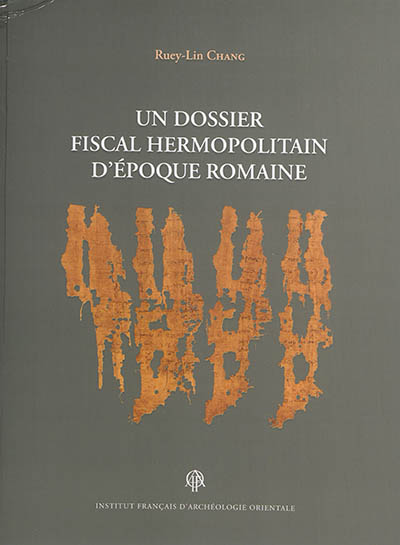
Dans cet ouvrage, une enquête est menée sur
un dossier fiscal constitué de trois rouleaux
de papyrus grecs entièrement inédits, datés
de l'an 3 de Trajan (99/100 apr. J.-C.) et provenant
d'Hermopolis, métropole du nome hermopolitain
(al-Ashmûnayn, Moyenne-Égypte). Ce dossier, conservé
à la Bibliothèque nationale et universitaire de Strasbourg,
se présente sous la forme d'un grand nombre de fragments
de papyrus fort mutilés. L'auteur a procédé à un travail
de remontage d'envergure, nécessaire avant une lecture
méthodique de ces manuscrits.
L'édition des textes, en partie sélective, est précédée d'une
introduction comportant une méthodologie de reconstitution
des papyrus, une analyse de la structure des textes,
une étude paléographique et une remise en contexte de la
documentation dans son cadre historique. La recherche
effectuée sur ce dossier complexe, mais essentiel pour
combler des lacunes de nos connaissances sur la fiscalité
d'époque romaine, livre une vue kaléidoscopique sur
la situation agricole et fiscale de la région sud du nome
hermopolitain, peu connue au tournant des I<sup>er</sup>-II<sup>e</sup> siècles apr. J.-C. Elle permet également de
pénétrer dans l'administration centrale du nome et de retracer plusieurs aspects de la technique
fiscale employée en Égypte romaine.
Un DVD permet au lecteur d'agrandir à volonté les photographies du papyrus.
Three unedited tax rolls of Greek papyri which constitute a coherent dossier of the Roman
taxation are investigated in this book. They come from Hermopolis (al-Ashmûnayn,
Middle Egypt), capital of the Hermopolite nome, and are datable to the year 3 of Trajan
(AD 99/100). These rolls, broken into a great number of seriously battered fragments and housed
in the Bibliothèque nationale et universitaire of Strasbourg, have been methodically reconstructed;
this reconstruction has allowed for a critical reading of the texts.
The edition of the selected texts is preceded by an introduction on the methodology of how the
papyrus fragments were reconsrtucted, an analysis of the structure of the texts, a palaeographical
study, as well as an exploration into the historical context. The research project on this dossier,
complex yet essential to a better understanding of the Roman taxation system in Egypt, offers an
unforeseen prospective on the agricultural and fiscal situation of the southern region of the Hermopolite
nome at the turn of the 2<sup>nd</sup> century AD; this is an area that has reamined under-researched.
This study also takes a closer look at the central administration of the nome and several technical
aspects of taxation system in Roman Egypt.
The attached DVD allows readers to enlarge at will the photographs of the papyri.