Berkeley revisited : moral, social and political philosophy
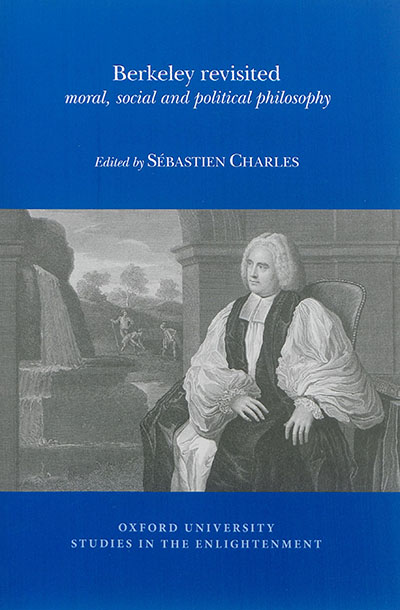
Since the publication of Paul J. Olscamp's The Moral
philosophy of George Berkeley (1970), research has focused
on Berkeley's theory of immaterialism as the defining
element of his thinking. New readings of his work
gathered in this volume position immaterialism as a
component of a much broader, overarching apologetic
project, which is highly pragmatic in nature.
Through close examinations of Berkeley's writings
on key political, economic, social, moral and ethical
debates, leading experts demonstrate that his writings
are not simply theoretical but also bound to a practical
concern with the well-being of humanity. The volume
opens with nuanced analyses of Berkeley's utilitarianism,
which contributors position more precisely as a
theological utilitarianism, a facet of natural law
and a theory with a distinctly pragmatic basis. This
doctrine is reconsidered in the context of Berkeley's
moral philosophy, with contributors highlighting the
implications of free will for the evaluation of personal
(or divine) responsibility for one's actions. Berkeley's
concept of desire is reconfigured as a virtue, when
channelled towards the common good of society.
Contributors close by reassessing Berkeley's political and
economic thought and uncover its practical dimension,
where individualism is sacrificed for the greater, national
interest.
The George Berkeley to emerge from this book is
a philosopher deeply concerned with the political,
economic and social problems of his time, whose
writings proposed practical and not simply theoretical
solutions to the challenges facing Britain in the
eighteenth century.