La statio : archéologie d'un lieu de pouvoir dans l'Empire romain
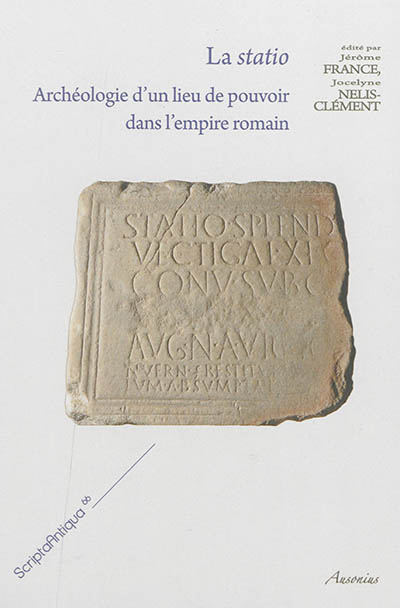
Cet ouvrage, fruit dune réflexion collective menée par des spécialistes de
plusieurs disciplines (archéologie, histoire, papyrologie, philologie, épigraphie),
cherche à préciser et à mettre en évidence, autour de la notion de statio et des
réalités matérielles qui s'y rattachent, les espaces fonctionnels dans lesquels
s'animent les contacts entre les agents du pouvoir et les populations locales,
dans les différentes régions qui constituent l'Empire romain. Les questions
posées et les domaines étudiés reflètent bien la diversité et l'ampleur du champ
dinvestigation : à quels types de structures font allusion le douanier se présentant
comme l'agent dune statio , le militaire dédiant un monument votif au Génie de
sa statio , ou les Tyriens, établis à Rome et à Pouzzoles, s'adressant à leur cité-mère
pour évoquer les difficultés liées à l'entretien de leur statio ? Que sait-on du
cadre et de l'implantation des réseaux des stationes dans les provinces romaines,
de leur organisation, des contacts entre les agents détachés et les communautés
locales ? En quoi les stationes douanières et militaires sont-elles comparables aux
mansiones ou mutationes établies le long des voies de communication ? Dans ce
volume, qui constitue le premier effort de synthèse consacré à lensemble de ces
questions, le lecteur est convié à appréhender, à la lueur des découvertes les plus
récentes, de nombreux aspects illustrant la vie de l'État romain.
This volume, the result of a collaboration between specialists from different
areas (archaeology, history, papyrology, philology, epigraphy), attempts to
define and present, from a focal point fixed on the concept of the statio and its
physical composition, the functional spaces within which took place contacts
between representatives of authority and local populations throughout the
Roman Empire. The questions asked and the topics covered illustrate clearly the
diversity and range of the subject: to what type of edifice is a custom's officer
referring when he describes himself as operating in a statio , or a soldier dedicating
a votive monument to the Genius of his statio , or the Tyrians installed in Rome
or in Pozzuoli when they write to their mother city to describe the difficulties
involved in assuring the up-keep of their statio ? How much do we know about
the context and the installation of networks of stationes in the provinces of
the Empire, about their organisation and the contacts between the authorities
and local inhabitants? To what extent are these military and customs out-posts
comparable to the mansiones and mutationes set up throughout the road system?
This study, the first attempt to offer a comprehensive study of these matters
and taking into account very recent archaeological discoveries, invites readers
to investigate numerous aspects of the organisation and administration of the
Roman State.