A worldwide review of fossil and extant glypheid and litogastrid lobsters (Crustacea, Decapoda, Glypheoidea)
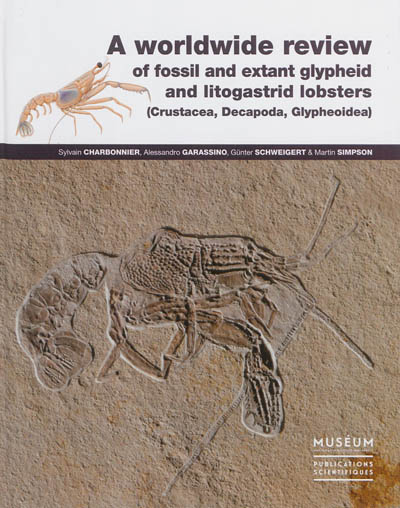
This volume is the first global review of the fossil and extant glypheoid lobsters (Eucrustacea,
Decapoda, Glypheoidea) included in the families Glypheidae and Litogastridae. Glypheoid lobsters
form a particularly specialised group of decapod crustaceans which are highly diversified in the fossil
record. They appeared in the Triassic, prospered in the Jurassic, and subsequently declined between the
Cretaceous and the Eocene. This group was thought to have become extinct in the Eocene until the discovery
and description of two extant species from the Pacific. Since 1822, more than 120 species of glypheoid lobsters
have been described, and numerous problems in their interprétation, and classification have accumulated in
the literature. Consequently, a thorough review with a synoptic approach is presented here. The main purpose
is to update the old literature and to revise ail the glypheoid genera and species based exclusively upon the
type specimens. All the proposed diagnoses and descriptions are presented using standard criteria and well
established descriptive terminology. Literal translations of the old diagnoses are now available in English for
the first time, which will help to demonstrate how the historical concepts of glypheoids have evolved over
time. Most of the taxa discussed are thoroughly documented and illustrated to allow comparisons between
the original figures and the updated versions. Thus about 990 specimens have been studied and are illustrated
in 583 figures. The ultimate aim of this volume is to bring together ail the data of the fossil and extant
glypheoid lobsters, and to set a new définitive framework which might become a standard method for all
decapod researchers.