L'iconographie ancienne d'Avalokitesvara. The early iconography of Avalokitesvara
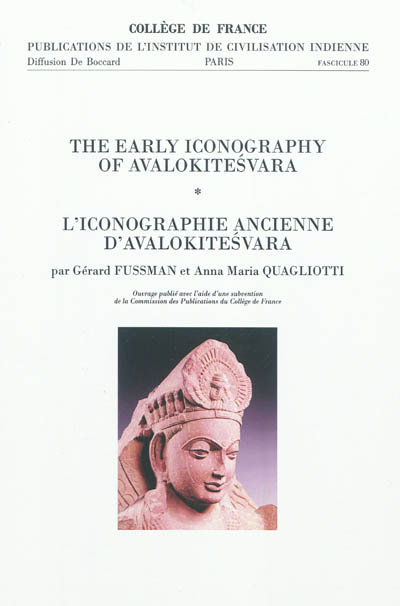
La première partie de ce livre, par G. Fussman, lie l'étude de deux
statues de la collection Pritzker à deux évolutions majeures du bouddhisme
dans les deux premiers siècles de notre ère : la création de l'image
anthropomorphique du Buddha et les débuts du mahayana, qui entraînèrent
la création d'images de nouveaux bodhisattva-s. Elle examine en
particulier les tâtonnements qui ont précédé la création de l'image
standard d'Avalokitesvara. L'étude de tout changement supposant
l'existence d'une chronologie relative et absolue, cette première partie
traite de la date de l'apparition de l'image humaine du Buddha au
Gandhara et revoit la chronologie de l'art bouddhique de Mathura en
refusant la théorie des «centaines omises». En seconde partie sont
réimprimés deux articles d'A.M. Quagliotti réfutant l'idée que les
« bodhisattva -s pensifs» soient tous des Avalokitesvara. Enfin un court
chapitre est consacré à l'analyse d'une stèle récemment découverte à
Mes-e Aynak (Afghanistan). Elle confirme les conclusions précédemment
atteintes par A.M. Quagliotti et G. Schopen.
The first part of this book, authored by G. Fussman, establishes a link
between two bodhisattva -statues in the Pritzker collection and two great
changes which happened in Buddhist devotion during the two first
centuries of the C.E., viz. the creation of an anthropomorphic image of
the Buddha and the beginnings of the mahayana movement, with, as a
consequence, the creation of images of new bodhisattva -s. Special attention
is given to the attempts at the creation of images of Avalokitesvara
which preceded the creation and adoption of the later standard imagery.
A chronology is needed for any study of change. No wonder if many
pages in the first part of the book are devoted to dating the first
Gandharan images of the Buddha and to a new examination of the
chronology of Mathuran Buddhist art, which concludes by discarding
the "omitted hundreds" theory. The second part of the book is a reprint
of two papers by A. M. Quagliotti, where she demonstrated that not
every "pensive boddhisattva" should be identified with Avalokitesvara.
In addition, G. Fussman analyses a stone stele recently discovered in
Mes-e Aynak (Afghanistan), whose iconography supports the conclusions
of A.M. Quagliotti and G. Schopen.