Vingt sonnets à Marie Stuart. Twenty sonnets de Mary queen of Scots
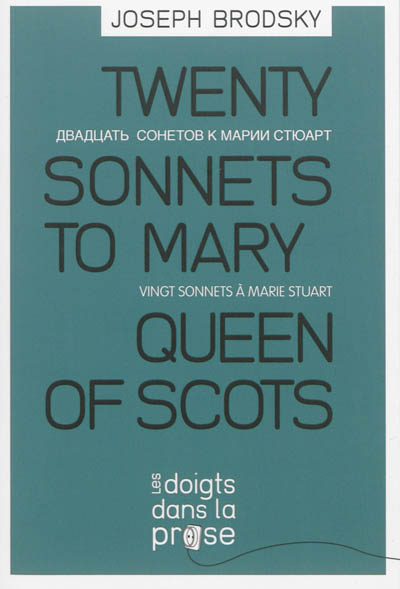
Édition quadrilingue
Cette édition séparée des Vingt sonnets
a Marie Stuart du grand poète américain
Joseph Brodsky, exilé involontaire et prix
Nobel de littérature, est inédite à bien des
égards. Elle propose le texte russe original,
la traduction anglaise de Peter France,
revue par l'auteur, mais aussi deux versions
françaises : celle de Claude Ernoult,
parue chez Gallimard, et celle d'André
Markowicz, jamais publiée en volume.
Le lecteur est ainsi invité à prendre la
mesure du travail de création qui rend
possible la traduction de poésie.
Au cours d'une promenade dans le Paris
des annés 70, le poète en exil croise la
statue de Marie Stuart au jardin du Luxembourg.
Le visage d'une femme jadis aimée
se superpose à celui de la reine d'Écosse.
Dans une langue qui joue sur les deux
registres du trivial et du sublime, de la citation
et de son détournement, l'évocation
amoureuse est l'occasion pour le poète
d'une rêverie mélancolique sur l'exil et la
séparation, la mémoire et l'histoire, la littérature
europeenne, les bifurcations de son
propre destin.
Quadrilingual edition
This seporate edition of Twenty Sonnets to
Mary Queen of Scots by the great Russian-
born American poet, Nobel Prize winner and
involuntary exile, Joseph Brodsky, is unusual
in several ways. It comprises the original
text in Russian, the English translation by
Peter France, revised by the author, and
two French versions : one by Claude Ernoult,
published by Gallimard and the other by
André Markowicz, for the first time in-print.
This juxtaposition enables the reader to
appreciate the creative work involved in
translating poetry.
While walking in Paris in the seventies, the
exiled poet came across the statue of Mary,
Queen of Scots in the Luxembourg gardens.
He encounters the gaze of a woman once
loved, a gaze that supersedes the regal face
of the Queen of Scotland. The poet employs
a language that plays on the registers of
both the trivial and the sublime, punctuating
his work with direct quotations and ironic
imitations of other poets. This evocation of
love provides Brodsky with the opportunity for
melancholic reverie on exile and separation,
memory and history, on European literature
and the meanders of his own destiny.