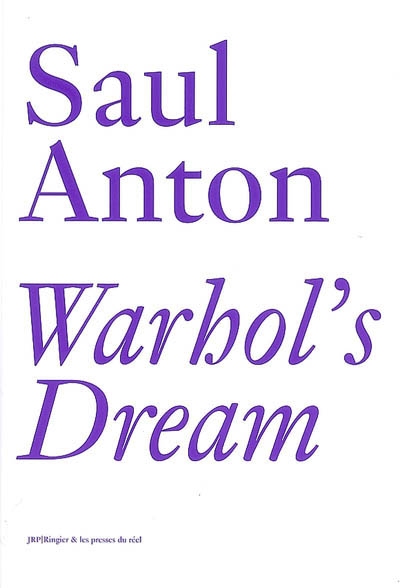
Warhol's dream
"It was a terrible night. The phone started ringing at 4 a.m., and every time I picked it up, there was
no one there. It took me an hour and a Seconal to fall asleep, but at 6 a.m. the same thing happened
all over again. This time, I couldn't fall asleep, so after tossing and turning for an hour, I called Brigid
and asked her if she'd called me and hung up..."
So begins Warhol's Dream , Saul Anton's fictional dialogue between Andy Warhol and Robert Smithson,
arguably two of the most influential artists of the 1960s.
Today, the work and influence of these two artists remain at the center of the "artworld," as well as
the tremendous expansion of museums, biennials, and galleries that has been ongoing since the
early 1990s in the US and worldwide. In Warhol's Dream , Saul Anton has written a critical fiction in
the form of a dialogue that takes up the impossible task of imagining what Andy and Bob just might
have had-and might still have-to say to one another. Taking the parodic and tonally sophisticated
voices at work in Warhol's The Philosophy of Andy Warhol and in Smithson's famous critical
writings as his points of departure, Anton explores the congruities and incongruities between their
theory and practice, and the way Warhol and Smithson confronted questions of objecthood, reproduction,
and temporality which remain crucial concerns for art today. At the same time, he also sets
out to imagine the critical voice and style that would do justice to the manner in which these artists
reconfigured and reimagined the relation between objects and language, work and its reproduction,
art and its history.