La lampe Gras
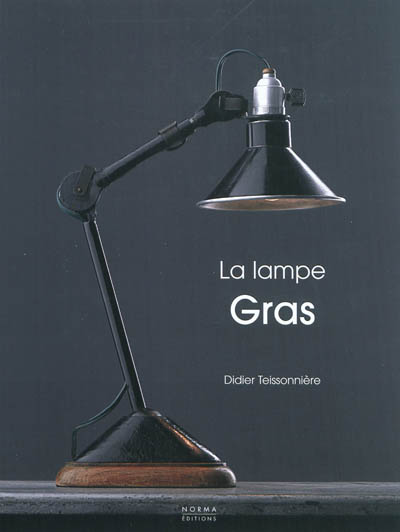
La lampe Gras a une place inédite dans l'histoire du luminaire. Conçue
et fabriquée en 1921, elle inaugure un genre nouveau de système d'éclairage
dont la vocation est de satisfaire aussi bien le monde de l'industrie que
le secteur tertiaire en plein essor.
À géométrie variable et aisément adaptable au gré des besoins de chacun,
la lampe Gras est à même d'éclairer de la façon la plus performante les
machines-outils, les planches à dessin, les bureaux, les laboratoires et jusqu'au
bloc opératoire du paquebot Île-de-France . Répudiant tout maniérisme
ornemental, son créateur, l'ingénieur Bernard-Albin Gras, l'a dotée d'une
esthétique relevant de cette adéquation parfaite du dessein et du dessin, qui
fonde ce qu'on appelle aujourd'hui le design.
Comme telle, son succès fut immédiat, au point de susciter interprétations et
imitations, notamment chez les membres du Bauhaus fascinés par cet incunable
de la modernité. Mais il revient à Le Corbusier de lui avoir conféré une aura
particulière, voyant en elle, selon ses propres termes, un «objet-outil» réduit à
sa pure fonctionnalité, un «objet type» dont il a fait bénéficier son agence
comme ses réalisations architecturales. À sa suite, Robert Mallet-Stevens, Eileen
Gray, Michel Roux-Spitz, Sonia Delaunay, Georges Braque et tant d'autres
figures de l'avant-garde l'ont adoptée, contribuant à la faire entrer dans la
légende. Cette carrière prestigieuse se double d'un succès plus anonyme dans
le monde du travail, exceptionnel par le volume de ses commandes comme par
sa durée. Il n'est guère d'autre exemple de lampe qui, sans modification
majeure, ait été éditée pendant plus d'un demi-siècle.
Après quelques décennies d'éclipse, la lampe Gras retrouve une notoriété
auprès d'une nouvelle génération d'architectes, de décorateurs et de
collectionneurs, fascinés par cet objet de la première modernité au même titre
que les meubles de Le Corbusier, Herbst, Prouvé et Perriand. Cet ouvrage
retrace l'histoire d'une invention et d'une aventure industrielle, mais il se veut
aussi une promenade à travers les choix esthétiques de l'entre-deux-guerres
et ceux, plus éclectiques, du temps présent.
The Gras lamp has an exceptional place in the history of the lamp. Designed
and manufactured in 1921, it pioneered a new system of lighting whose
vocation was to meet the demands of both the world of industry and the
rapidly developing service sector.
Easily adaptable to each user's needs, the Gras lamp efficiently lit machine
tools, drawing boards, offices, laboratories, and even the operating room of the
ocean liner Île-de-France. Eschewing ornamental mannerism, its creator, the
engineer Bernard-Albin Gras, endowed it with an aesthetic that was the product
of the perfect harmony of purpose and design, the basis for what is now
known as "design."
As such, the lamp's success was immediate, so much so that it inspired
imitations, notably by members of the Bauhaus school fascinated by this
incunabulum of modernity. But it was Le Corbusier who imparted it with a
distinctive aura, seeing in it, in accordance with his own terms, an "object-tool"
reduced to its pure function and a "type objet" that he used both in his office
and architectural works. Following suit, Robert Mallet-Stevens, Eileen Gray,
Michel Roux-Spitz, Sonia Delaunay, Georges Braque, and many other
avant-garde figures adopted the lamp, helping it go down in legend.
This prestigious career went hand in hand with a more anonymous success
in the workaday world, which was exceptional both in terms of the volume
of orders and its longevity. There are practically no other examples of lamps
that were continuously manufactured - without any major modifications - for
over half a century.
After a few decades of obscurity, the Gras lamp found favor with a new
generation of architects, interior decorators, and collectors fascinated by the
object, a product of early modernism in the same way as the furniture of
Le Corbusier, Herbst, Prouvé, and Perriand. This book recounts the history
of an invention and an industrial adventure, and is also meant to be an
exploration of the aesthetic choices of the interwar period and the more
eclectic ones of the present.