Iconoclasm in revolutionary Paris : the transformation of signs
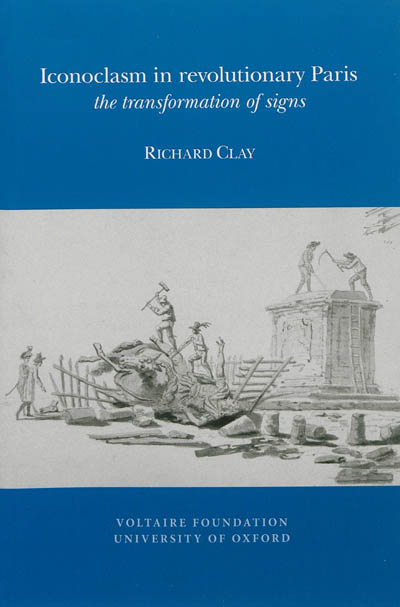
From Ancient Egypt to the Arab Spring, iconoclasm
has occurred throughout history and across cultures.
Both a vehicle for protest and a means of imagining
change, it was rife during the tumultuous years of
the French Revolution, and in this richly illustrated
book Richard Clay examines how politically diverse
groups used such attacks to play out their own
complex power struggles.
Drawing on extensive archival evidence to uncover
a variety of iconoclastic acts - from the beheading
or defacing of sculptures, to the smashing of busts,
slashing of paintings and toppling of statues - Clay
explores the turbulent political undercurrents in
revolutionary Paris. Objects whose physical integrity
had been respected for years were now targets for
attack: while many revolutionary leaders believed
that the aesthetic or historical value of symbols
should save them from destruction, Clay argues that
few Parisians shared such views. He suggests that
beneath this treatment of representational objects
lay a sophisticated understanding of the power
of public spaces and symbols to convey meaning.
Unofficial iconoclasm became a means of exerting
influence over government policy, leading to
official programmes of systematic iconoclasm that
transformed Paris.
Iconoclasm in revolutionary Paris is not only a major
contribution to the historiography of so-called
'vandalism' during the Revolution, but it also has
significant implications for debates about heritage
preservation in our own time.