Bernard Tschumi : architecture, concept & notation
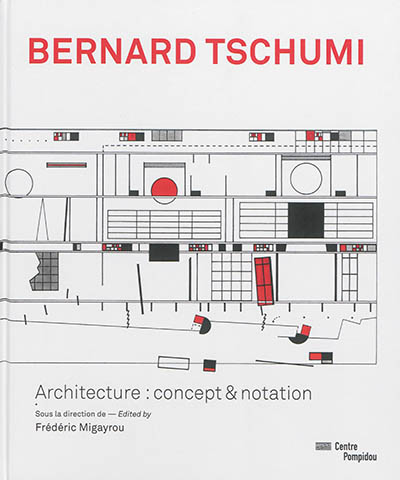
Édité à l'occasion de l'exposition rétrospective de Bernard Tschumi
au Centre Pompidou, cet ouvrage retrace les moments clés du travail
de l'architecte. Abondamment illustré, il souligne deux principes
au coeur de son activité. Tout d'abord, l'architecture doit reposer sur
des idées et des concepts plutôt que sur des formes. Ensuite, elle
est indissociable des événements et des mouvements des corps qui
l'habitent, d'ou la nécessité d'explorer de nouveaux modes de notation
pour construire les projections architecturales qui donneront corps
à ces interactions entre espace, mouvement et action.
Depuis les Manhattan Transcripts , projet majeur aux frontières de l'art,
de la littérature et du cinéma, jusqu'au musée de l'Acropole, à Athènes,
et la manufacture horlogère Vacheron Constantin, à Genève, en passant
par le Parc de la Villette et l'architecture du Parc zoologique de Paris,
ce catalogue au ton très personnel s'interroge sur les enjeux actuels
de l'architecture.
Proposant des textes de Frédéric Migayrou, d'Aurélien Lemonier et
de Bernard Tschumi, ce volume exceptionnel s'adresse autant au grand
public qu'aux amateurs d'art et d'architecture.
Published on the occasion of the retrospective exhibition of the work
of Bernard Tschumi at the Centre Pompidou, this catalogue retraces
key moments in the architect's practice. Abundantly illustrated,
it argues two fundamental points at the center of Tschumi's practice.
First, architecture must be made out of ideas and concepts before
becoming form. Second, it cannot be dissociated from the events and
movement of the bodies that inhabit it. In consequence, architecture
demands new modes of notation to construct an architectural language
capable of embodying the interactions between space, event, and
movement.
Covering major projects extending from the early Manhattan Transcripts,
situated at the borders of art, literature, and cinema, to the Acropolis
Museum (Athens) and the Vacheron Constantin Headquarters (Geneva)
and including the Parc de la Villette and the architecture of the new Paris
Zoological Park, this volume, with its often personal tone, inquires into
what architecture can be today.
Texts by Frédéric Migayrou, Aurélien Lemonier, and Tschumi round out
an exceptional volume addressed to the public as well as a specialized
art and architecture readership.